
Rich County Scheduled Versus Actual Release
A projected or scheduled date is a future administrative expectation. It is not the same fact as an actual exit from custody. For a Utah state prisoner, the public Utah Department of Corrections terminology is Parole/Expiration Date. A parole date comes from Board authority and may remain subject to later action or processing. An expiration date refers to the sentence framework shown in the record. Neither label should be rewritten as a guaranteed Rich County release date.
County cases differ. A person held before trial may leave after bond, a court order, dismissal with no other hold, or another legal change. There may be no sentence from which to calculate a date. A person serving a Rich County jail term may have a jail calculation based on the commitment, credit for time served, and applicable law. Rich County publishes no local calculator, so a date from an unofficial estimate has no official force.
Lookup Rich County Projected Release Dates
Begin with custody type. The official UDC search is appropriate for a person incarcerated by UDC or currently supervised on parole or probation. It expressly excludes unsentenced people awaiting trial in county jails. A UDC no-result therefore cannot answer a local Rich County booking question. It also may not preserve a profile after full discharge because the search covers current supervision.
- Ask whether the person is in Rich County Jail, a Utah prison, another county, federal custody, or a different receiving agency.
- For Rich County pretrial detention, check the court case for bond or a release order, then call the jail at 435-793-2285 to confirm completion and any hold.
- For a county sentence, request the judgment or commitment and the jail's date calculation. Ask how credit for time served was applied.
- For state prison, search the UDC Offender Search by full name or UDC number and record the exact Parole/Expiration Date label.
- Search the BOPP decision system. Open the decision that grants, changes, rescinds, or terminates the date.
- Near the planned day, confirm the event with UDC, BOPP, AP&P, or the jail that has custody.
The official UDC search page shows the name and offender-number inputs as well as its warning about current supervision.
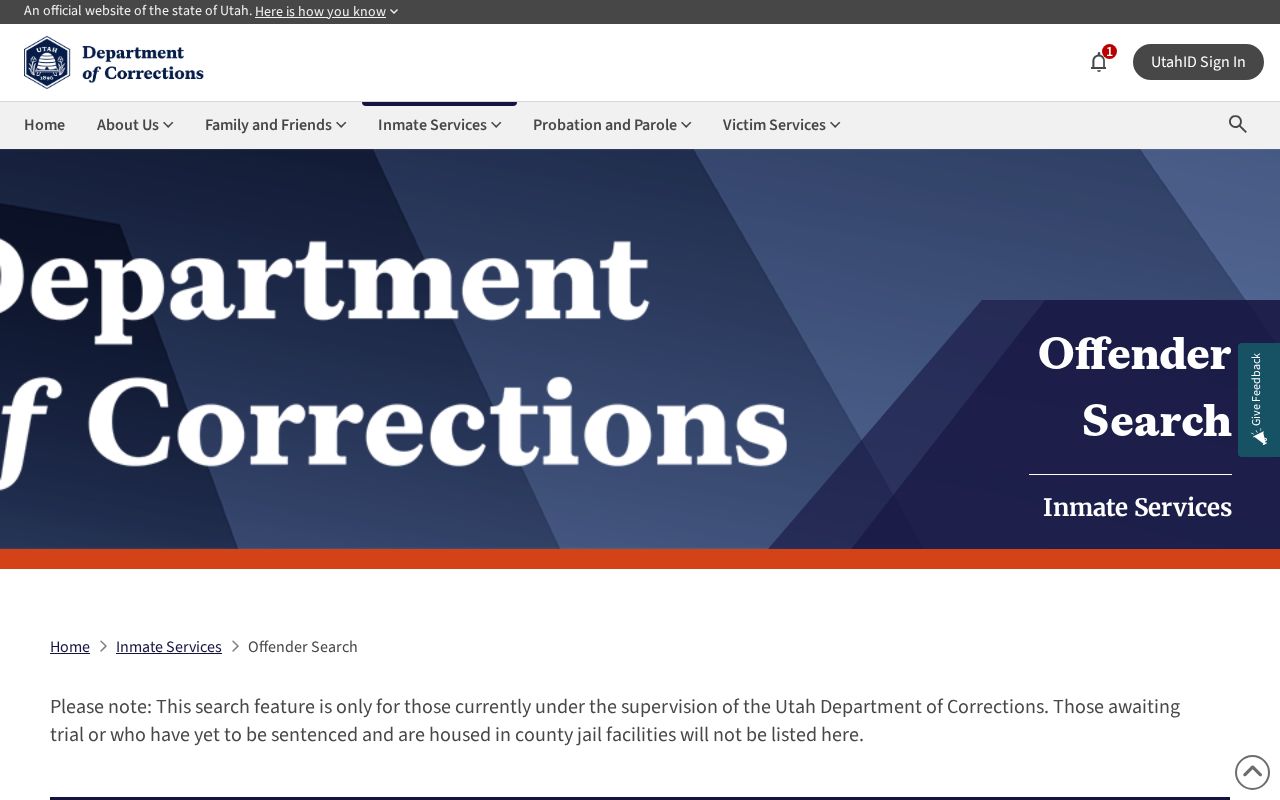
That scope warning is central: the portal is useful for the state path, but it is not a Rich County jail release roster or a complete historical discharge archive.
Note: Match the UDC number and sentencing case when possible, since a common name or alias can lead to the wrong record.
Rich County Pretrial Release Dates
A Rich County pretrial detainee usually has no sentence-based projected date. The next custody event may depend on bond, an own-recognizance order, dismissal, a plea, a sentencing decision, or a hold from another case or agency. A scheduled hearing is not a release date. Even a signed release order establishes legal authority rather than the exact time jail staff completes identity checks, property processing, and the hold review.
Review the correct court. Rich County Justice Court handles most lower-level misdemeanors, infractions, and traffic matters, while First District Court handles felonies and class A misdemeanors. XChange can show bond and chronological case entries, subject to access rules and entry timing. Match the person and case number. Then call the jail to ask whether the order was received and whether another hold prevents community release.
If local custody ended through transfer, there is still no Rich County community release date to project. Ask for the receiving agency. A UDC commitment moves the search to state corrections, while a federal or immigration transfer follows its own locator and record path. Preserve the Sheriff's transfer disposition because it connects the two custody systems.
Do not turn a court calendar date into an estimate. Hearings can be reset, orders can require more steps, and the jail must check all active authority before ending custody. The recorded release time is the final local fact.
Utah Rich County Release Calculations
Utah uses indeterminate sentencing for state prison cases. The court sets a lawful range rather than a single mechanical exit day in many cases. BOPP then decides whether and when parole will be granted before maximum expiration, subject to the statute, sentence, offense rules, and individual record. Utah does not impose one universal rule that every state prisoner serves about 85 percent. Importing that slogan or a federal credit formula produces a false Rich County projected release date.
Under Utah Code §77-27-7, the Board follows the hearing and release process after commitment. An original hearing is a chance for Board action, not automatic eligibility on that date. The Board may grant parole, order a rehearing, direct sentence expiration, or issue another case-specific decision. Life without parole and offense-based limits follow their own law.
A Board result may not be announced at the hearing. The written order controls. Salt Lake and Gunnison calendars can help locate proceedings, but a calendar row is not a release order. When a future parole date appears, check whether a later order changed it. This matters because rescission can withdraw a granted date before the person leaves prison.
Rich County Earned-Time Rules
Utah earned time is governed by §77-27-5.4. The law permits Board-authorized reductions for qualifying completion of approved programs. Research identifies at least four months for qualifying completion and generally up to two specified programs, with discretion and exclusions in the statute. It is not a self-applied subtraction from the maximum sentence.
The Board may consider credits after a later decision when no date yet exists. Credits can also be lost in rescission circumstances. The exact statutory version, approved-program status, and BOPP order must all align. A public calculator cannot see those facts. For a Rich County person in UDC custody, read the decision history instead of guessing from sentence length.
County confinement has a separate calculation. Utah Code §76-3-401 addresses sentence and credit issues relevant to county confinement, but Rich County has not published a local good-time calculator or house formula. Request the jail's computation and compare it with the judgment. If a credit entry seems wrong, the jail or court must address it.
Credit for time served means qualifying time already spent in custody is counted as the judgment and law require. It is not the same as Utah's state-prison earned-time program. The county custodian applies the local sentence computation, while BOPP controls the state parole decision. Mixing those systems can shift an estimate by months and can send a request to the wrong office. Ask for the calculation actually used in the person's case, including the commitment date, credited days, and any later correction that the agency is permitted to disclose.
Note: Earned time affects Board decision-making only as the law permits; it does not create a guaranteed exit date on its own.
Why Rich County Release Dates Change
A projected date can move for legal, custodial, or operational reasons. The source of the change helps identify which record to check next. A later BOPP order belongs in the Board history. A new court case belongs in the docket. A hold or transfer must be confirmed by the current and receiving agencies. Do not treat every change as a clerical delay.
| Factor | Possible effect | Best record |
|---|---|---|
| Later Board order | Grants, changes, or replaces the prior date | BOPP decision PDF |
| Earned-time action | May reduce a date within statutory authority | BOPP order and program record |
| Rescission | Withdraws a future granted parole date | BOPP rescission decision |
| New or pending case | Can add custody or affect release | Court docket and custodian |
| Consecutive sentence | One term follows another | Judgment and sentence calculation |
| Credit correction | Changes time credited toward a county term | Jail calculation and court record |
| Detainer or hold | Can produce transfer instead of community release | Release disposition and receiving agency |
A detainer is a request or authority that can keep a person held or move that person to another custodian. One agency may record “released” when it turns custody over. That is not necessarily freedom from all custody. Ask for the destination.
Tuesday Utah Prison Release Processing
Utah has a distinctive state-prison process. UDC says releases and paroles are normally processed on Tuesdays at Utah State Correctional Facility, even for most UDC prisoners housed at Central Utah Correctional Facility or in county contract beds. A legal parole date and the physical exit event are therefore separate facts. This process does not govern an ordinary Rich County bond release.
The official UDC Release Day page gives the Utah State Correctional Facility logistics and tells readers how to verify the date.
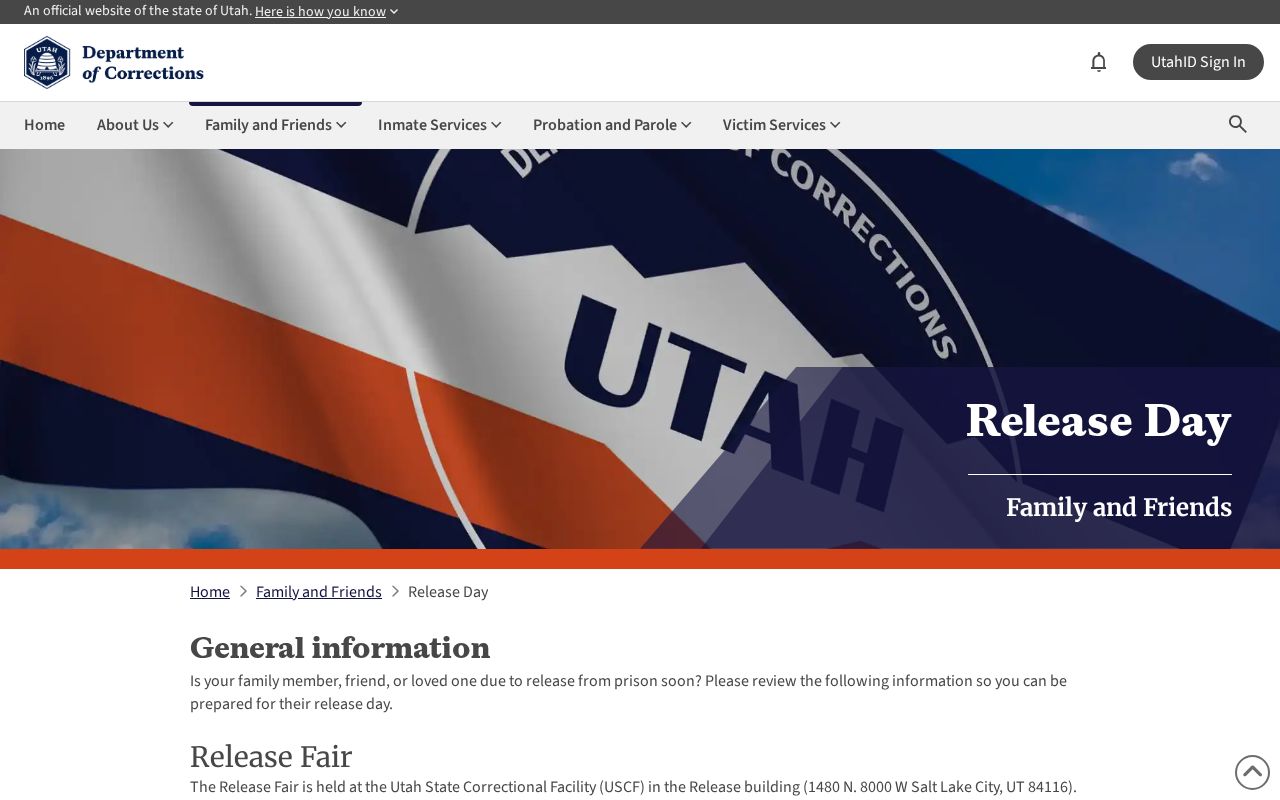
The pictured state instructions show why a scheduled day still needs completion confirmation. They cannot be applied to Rich County Jail, where release hours and local transport details were not published.
Confirm Rich County Actual Release
Use the agency that physically holds the person. For Rich County Jail, call jail staff and ask whether processing is complete, when local custody ended, and whether the disposition was community release or transfer. A court order proves authority, but another case or hold may delay the exit. Request the booking and release record when written proof is needed.
For state prison, compare the UDC legal status and Parole/Expiration Date with the BOPP order. A past date deserves an actual status check. If parole began, Region 2 Logan AP&P serves Rich County and can address permissible supervision questions. Full sentence termination is different from parole and may explain why a person later disappears from the current-only UDC search.
VINE can alert on a custody event, but data can lag or fail. BOPP presently warns of inaccurate or missing notices. The Rich County VINELink check explains the alert process, while the custodian remains the source for final confirmation. Keep the order, agency record, and event timestamp distinct.