
Rich County Parole Versus Probation
Utah separates the authority that imposes supervision from the office that manages it. The Utah Board of Pardons and Parole, commonly called BOPP, may grant parole from an indeterminate prison sentence. Parole means the person has left secure prison custody under stated conditions but remains under state authority. A sentencing court orders probation. Probation can follow a Rich County jail term, or the court can order it instead of a prison commitment. Utah Department of Corrections Adult Probation and Parole, or AP&P, supervises many people in both groups.
The Rich County Sheriff does not decide state parole and is not the supervising agency. The jail release record can show when local custody ended, but the BOPP order or sentencing docket explains why supervision began. Use both when the custody path is unclear. The Rich County released-inmate search and records path explains how to obtain the local release entry.
| Point | Parole | Probation |
|---|---|---|
| Who orders it | Utah Board of Pardons and Parole | Sentencing court |
| Custody path | Conditional release from a state prison sentence | Court supervision that may follow jail or replace prison |
| Primary public record | BOPP decision plus current UDC status | Court docket plus current UDC status |
| Local supervision contact | AP&P Region 2 Logan | AP&P Region 2 Logan when assigned by UDC |
| How it ends | Board termination or sentence expiration | Court or agency discharge under the order |
- Parole
- Conditional community release from a prison sentence.
- Probation
- Court-ordered supervision in the community.
- Discharge
- The formal end of the stated supervision term.
- Absconder
- A supervised person reported as no longer complying with contact requirements or location rules.
Check Rich County Supervision Status
Verification works best as a sequence. Start with identity, then match the agency and record. The UDC Offender Search accepts a first and last name or a UDC offender number. It covers people currently incarcerated by UDC or currently on probation or parole. It does not cover a Rich County detainee who is awaiting trial and not yet sentenced. A fully discharged person may also stop appearing because the portal is limited to current UDC supervision.
- Collect the full legal name, any middle name, and the UDC number when known.
- Run the official UDC search. Compare the legal status, location, and identifying details instead of relying on a name alone.
- If parole is shown or expected, search BOPP Hearings and Decisions by name or offender number. Open the actual decision.
- If probation is expected, review the Utah court case through XChange or the clerk to locate the sentencing and probation entries.
- Contact the assigned AP&P office for permissible current verification. Do not assume the office from an old home address or arrest county.
- For a completed term, request the discharge or termination record when the current-only UDC search no longer returns a result.
The official BOPP search page shows the name, offender-number, and date-range controls used to find Utah hearing and decision records.
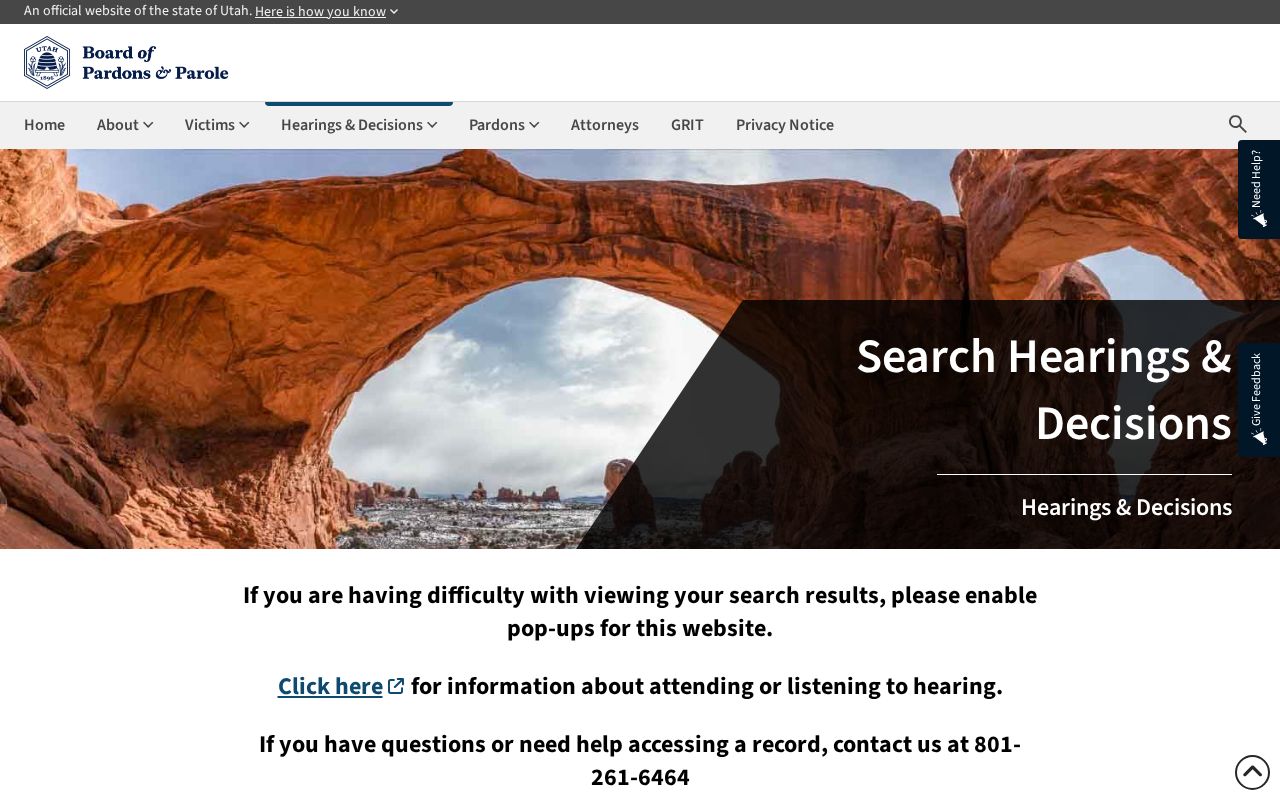
The decision document, not the result-row date alone, states whether the Board granted parole, set a rehearing, rescinded a date, or ended a sentence.
Note: A UDC no-result can mean discharge, a name mismatch, or no UDC case, so it is not proof by itself.
Rich County AP&P Office
Rich County has no AP&P office inside the county. The official assignment is Region 2 Logan, which expressly serves Cache and Rich Counties. That detail matters. A person released from Utah prison may report outside Rich County even when the arrest, home, or court case was local. Office assignments can change, so the current UDC probation and parole directory should be checked before travel.
AP&P Region 2 Logan
775 West 1000 North, Suite 120
Logan, UT 84321
Phone: 435-713-6240
Statewide AP&P: 801-545-5908
Call this office when the question concerns an assigned Utah parole or probation case. For a Rich County jail booking, release time, or transfer destination, call the jail at 435-793-2285 instead. The two offices hold different records. Neither should be asked to certify the other's action.
Rich County Parole Decision Records
Utah uses indeterminate prison sentences. The court imposes the lawful range, while BOPP makes an individualized release decision within its authority. An original hearing date is not a promised exit date. The Board may grant a future parole date, order a rehearing, direct sentence expiration, or take another action allowed by the case. Under Utah Title 77, Chapter 27, the order and applicable sentence rules control.
Board decisions generally follow deliberation rather than being announced at the hearing. A result can take several weeks under BOPP materials. Later review also matters. A rescission can remove an already granted future date. A parole-violation proceeding may lead to reinstatement, a new date, an evidentiary hearing, or another specific order. Read the whole document and note its date.
The official hearing and review explanations distinguish those Board actions.
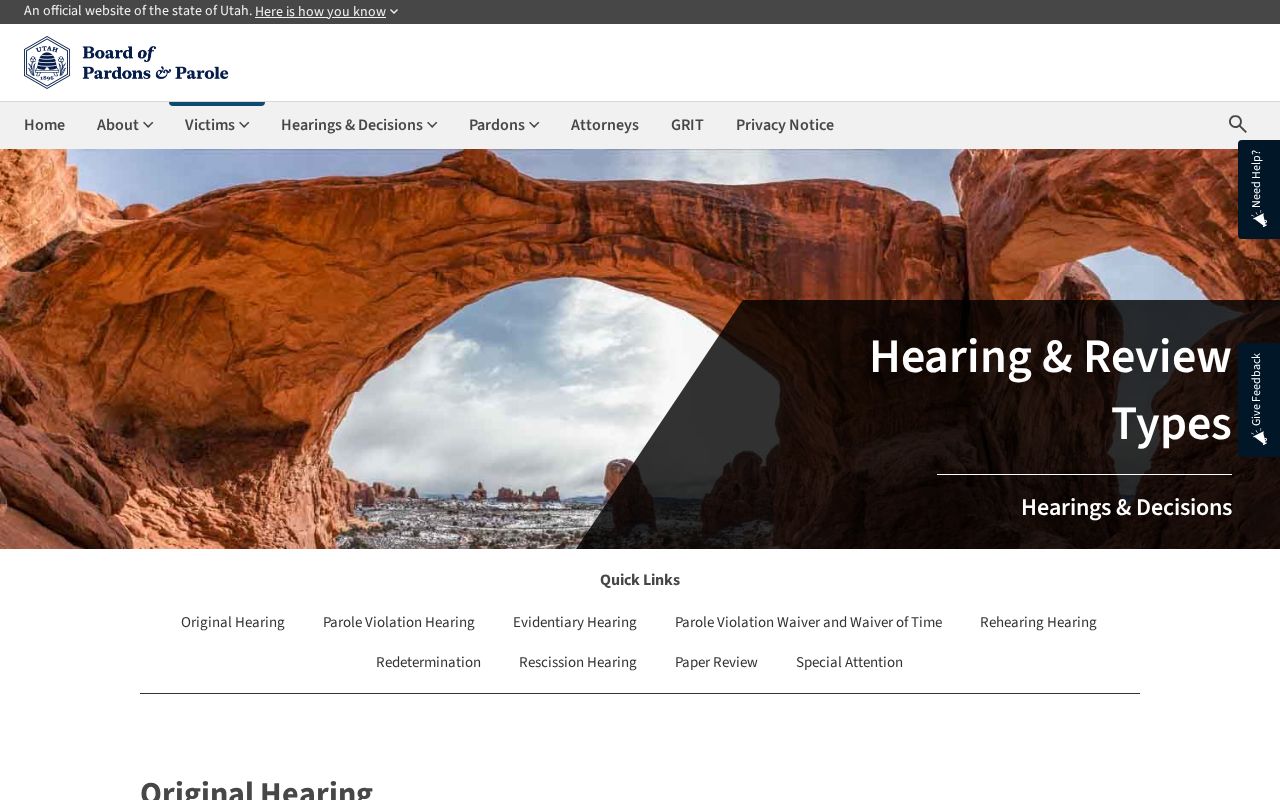
Those definitions prevent a hearing listing from being mistaken for a completed Rich County release or a final supervision discharge.
Rich County Probation Court Records
A probation status should be traced to the sentencing court. Rich County Justice Court handles most class B and C misdemeanors, infractions, and traffic matters, while First District Court handles felonies and class A misdemeanors. Both share the Randolph courthouse contact. Utah Courts XChange can show the charge, plea, judgment, sentence, probation entry, warrant, and later satisfaction or termination when those items are public. A court terminal or clerk is the fallback when an online document is unavailable.
The docket explains legal authority, but it may not name the current field office or show each contact with a supervising agent. Match the case by more than a name. Use the case number, middle name, date, and charge. MyCase is intended for a party's own eligible matter and is not a general public name-search substitute. Sealed, expunged, juvenile, private, or otherwise restricted entries may not display.
A probation order can exist without a recent prison release. Conversely, a Rich County jail record may show that custody ended before a probation docket entry becomes visible. Compare the dates, then ask the court or AP&P which record reflects the current order. This keeps a court-imposed status distinct from the Sheriff's role as the keeper of the local booking and release record.
Rich County Supervision Changes
Conditions are the rules attached to release or probation. The exact order controls, so broad summaries cannot replace it. Common categories may concern reporting, approved residence, treatment, travel, restitution, or contact, but no condition should be attributed to a specific Rich County person without the actual record. AP&P monitors compliance. The court controls probation orders, while BOPP retains authority over parole decisions and violation outcomes.
A violation allegation does not by itself establish the final result. A warrant, return to prison, recalled warrant, reinstatement, evidentiary hearing, or new Board date can each produce a different record trail. Rich County had no official county absconder list in the reviewed sources, and no statewide public AP&P absconder list was found. Check BOPP decisions and contact AP&P. Absence from the jail roster is especially weak evidence because Rich County publishes no official online roster.
VINE can send a custody event notice, but it is not a supervision ledger. BOPP currently warns that VINELink notices can be missing or inaccurate and directs people seeking verified Board status to 801-261-6464. Use the originating order and agency confirmation.
Rich County Supervision Notifications
Utah VINE provides automated custody-event notices by telephone or email when the source agency participates and reports an event. Its events may include release, transfer, escape, return, or movement between correctional settings. Those terms do not all mean the same thing. A transfer notice can mark the end of one custody record while another agency immediately takes control. VINE does not issue a probation discharge order or replace a BOPP parole decision.
The Utah Sex and Kidnap Offender Registry is another separate post-release system. It covers only people with a statutory duty to register. A profile may remain public after physical release and after another locator stops returning the person, but it is not proof of the release date or the end of supervision. Absence from the registry says nothing about a case that carries no registration duty. Use each system only for the fact it is designed to report.
BOPP's reliability warning makes direct confirmation important. If a notice conflicts with a Board order or UDC status, note which agency supplied the event and when. Call BOPP at 801-261-6464 for verified Board status, or AP&P Region 2 Logan for an assigned supervision question. For an ordinary Rich County jail event, the Sheriff remains the local source.
Rich County Supervision Discharge
Parole, probation, and sentence termination are not interchangeable. Parole is supervised release from prison custody. Probation is a court-based status. Termination, expiration, or discharge marks the end described in the governing order or record. A person can leave Rich County Jail yet remain on probation. Likewise, a person can leave USCF on parole and remain searchable through UDC because state supervision continues.
When supervision ends, preserve the best official proof. For parole, look for the BOPP order showing sentence expiration or termination and seek UDC information if needed. For probation, review the court docket for satisfaction, termination, or discharge. Utah's UDC search may no longer show a fully discharged person. Historical BOPP decisions, court records, and a focused GRAMA request are therefore more durable than a live locator.
Sealed or expunged material may no longer appear publicly. That access change does not make an old missing search result self-explanatory. Confirm the case identity, the order, and the agency that held authority. This gives a sound account of whether a Rich County post-release supervision term is active, changed, or complete.
Note: Verify a future parole date again after its stated date because later Board action or processing can change the outcome.