
Rich County Release Records Explained
A Rich County release closes one booking or commitment. It does not always mean the person is free of every legal restraint. Someone may leave the Rich County Jail on bond, after a court order, when a county sentence is complete, or when no charge or hold remains. Another person may leave only because Utah corrections, another county, the U.S. Marshals Service, or immigration authorities assumed custody. The key fact is the recorded disposition. Ask where the person went, not just whether the name is gone.
The Sheriff keeps the local booking and release record after custody ends. The related case remains with the Justice Court or First District Court. If a state prison sentence or Utah supervision follows, the Utah Department of Corrections and Board of Pardons and Parole create separate records. Federal custody has its own locators. These records may update at different times, so one missing result cannot prove a Rich County inmate was released.
- Parole
- Conditional release from a Utah prison sentence under the parole board, with supervision continuing.
- Probation
- Court-ordered community supervision that may follow jail or take the place of a prison term.
- Discharge
- The end of the stated correctional sentence or supervision term, rather than release to parole.
- Detainer
- A hold asking the current custodian to keep or transfer a person for another agency.
Rich County Custody Exit Types
Local records use the authority and outcome tied to a particular booking. Similar words can describe very different events. A court order may authorize release while staff still checks other warrants or holds. A dismissed charge does not end custody when another case remains. Probation can begin after the jail stay, while parole follows a state prison sentence. Death ends custody but should not be grouped casually with people released to the community.
| Recorded outcome | Meaning | Next record to check |
|---|---|---|
| Bond or recognizance | Physical custody ends while the case and release conditions continue. | Rich County release record and court docket |
| Time served | The stated county term is credited as complete. | Judgment, credit calculation, and release entry |
| Probation | Community supervision is ordered by a court. | Court order and UDC Adult Probation and Parole when applicable |
| Parole | Secure state prison custody ends, but the sentence remains supervised. | Board decision, UDC status, and AP&P |
| Transfer | Rich County custody ends because another agency takes control. | Receiving agency and sheriff transfer record |
| Expiration or discharge | The stated sentence or supervision term ends. | Board order, UDC record, and court history |
A transfer is not community release. The same point applies when one agency reports “release” at the moment another books the person. Record the name of the receiving agency and trace the next admission. That distinction keeps a county event, a prison parole, and a federal custody change from being collapsed into one answer.
Rich County Release Record Fields
Rich County does not publish a fixed release-sheet layout online. The field list below is therefore a request inventory, not a promise that every item appears on one form. The strongest local record links the booked identity and booking number to when custody ended, why it ended, and where the person went. Ask for exact time when a day alone is not enough.
| Requested field | What it can establish |
|---|---|
| Booked name and identifiers | Which person and booking the response concerns |
| Booking number and date | The local custody event tied to the release |
| Arresting agency and case | The agency and court matter behind the stay |
| Charge and bond information | The listed basis for custody and any bond route |
| Release date and time | When Rich County recorded the end of that booking |
| Release reason or authority | Bond, court order, completion, dismissal, or another stated ground |
| Destination or receiving agency | Whether the event was community release or transfer |
The booking entry, incident report, court docket, judgment, Board order, supervision record, and VINE event serve different roles. A phone confirmation may be the freshest same-day source. The written sheriff record gives firmer proof of what physically happened. Court or Board records explain the authority. VINE gives notice, but it is not a certified release sheet.
Request Rich Release Sheets Separately
Rich County's current sheriff records instructions require a written request for each record, a reasonably specific description, requester contact details, and a copy of government photo identification. That makes precision important. A booking and release sheet and a booking photograph should be listed as separate records. Asking for an incident report alone may not produce either one. Each record is reviewed, and access is not assured merely because an arrest occurred.
Describe the person, approximate booking date, arresting agency, and booking or case number when known. For the custody record, request the booking date and time, release date and time, release disposition, and receiving agency if transferred. For the image, identify the booking photograph tied to that booking number and date. Classification, privacy, investigative limits, sealing, or expungement may lead to redaction, partial access, or denial.
Order a Rich County Release Record
The official Rich County sheriff records sheet directs requests to the Records Department by email or mail. The current sheet lists a $35 GRAMA charge and asks requesters to allow a ten-day grace period. Confirm the fee before ordering because older county schedules differ and the live instructions control. Utah law separately sets the agency response rules.
- Identify one record and one booking as precisely as possible. Include the full name, approximate booking date, and case or booking number when known.
- Complete the official GRAMA form. Add requester contact details and the ID copy required by the county instructions.
- Send it to secretary@richcounty.gov or mail it to Rich County Records, P.O. Box 38, Randolph, UT 84064.
- Confirm the current charge and scope with Records at 435-222-5977. Keep the response, denial basis, and appeal information together.
P.O. Box 38
Randolph, UT 84064
435-222-5977
secretary@richcounty.gov
Under Utah Code §63G-2-204, an agency generally responds as soon as reasonably possible and within ten business days, or within five business days when the statutory expedited public-benefit test is established. The statute governs even though the county sheet uses the phrase “grace period.”
Utah Law on Rich Release Records
Utah's Government Records Access and Management Act, or GRAMA, is Title 63G, Chapter 2. It provides the classification and access framework. Section 203 addresses reasonable actual-cost fees, possible waivers, and prepayment. Sections 201 and 301 address access and public classifications. Other provisions protect private, controlled, investigative, security, juvenile, sealed, and expunged material.
A booking is not automatically public in full. The custodian may redact or withhold material and must identify the legal basis for a denial as required by GRAMA.
Utah Archives retention schedules govern how long an agency keeps an approved record series. Retention is not the same as web visibility. Rich County has no official online roster whose display term can be measured. An expungement order under Title 77, Chapter 40a can restrict agency and public access as the law directs, but the certificate process alone does not seal a case. Sealed, expunged, and juvenile matters also disappear from public court products.
Find a Released Rich County Inmate
Begin with the custody system. An ordinary Rich County booking, a Utah prison sentence, a federal prosecution, and immigration detention create separate trails. Ask where the arrest occurred, which agency booked the person, whether a judge ordered county jail or state prison, and whether another agency placed a hold. Then match the lookup to that path.
- Call Rich County Main Dispatch/Jail at 435-793-2285, or the alternate line at 435-946-3210. Ask whether custody ended and whether the outcome was community release or transfer.
- Request the sheriff booking and release record when written proof is needed. A named, date-bounded request is stronger than an unsupported third-party listing.
- Search Utah Courts XChange for the right Rich County court and case. Use the docket to identify bond, dismissal, sentence, probation, commitment, warrant, or termination entries.
- Use UDC and the parole board only if state corrections had jurisdiction. Use the federal locator only for a federal prison record.
- Compare two sources when possible: the custodian's release or transfer entry for what happened and the court or Board order for why.
Rich County publishes no current jail roster. Even where a live list exists elsewhere, a missing name proves neither release nor transfer.
The Rich County 24-Hour Release List details the same-day fallback when no official feed exists. For older events, the records request and court history are more durable than a live status tool.
UDC Search for Rich Releases
The Utah Department of Corrections Offender Search covers people currently incarcerated by UDC or supervised on probation or parole. It expressly excludes unsentenced county detainees. A fully discharged person may also stop appearing because UDC limits the public search to current supervision.
| Search or result field | How to use it |
|---|---|
| First and last name | Enter at least one letter in each; add a middle name when useful. |
| UDC offender number | Prefer this identifier for common names or aliases. |
| Legal status and location | Distinguish incarceration, parole, probation, and current placement. |
| Board hearing date | Treat it as a hearing event, not a release date. |
| Parole/Expiration Date | Read the official label and verify it against the Board decision. |
The official search screen shows the inputs and current-supervision warning. Review it at the source before choosing a record.
Open the UDC offender search to compare a name or offender number with the exact legal status.
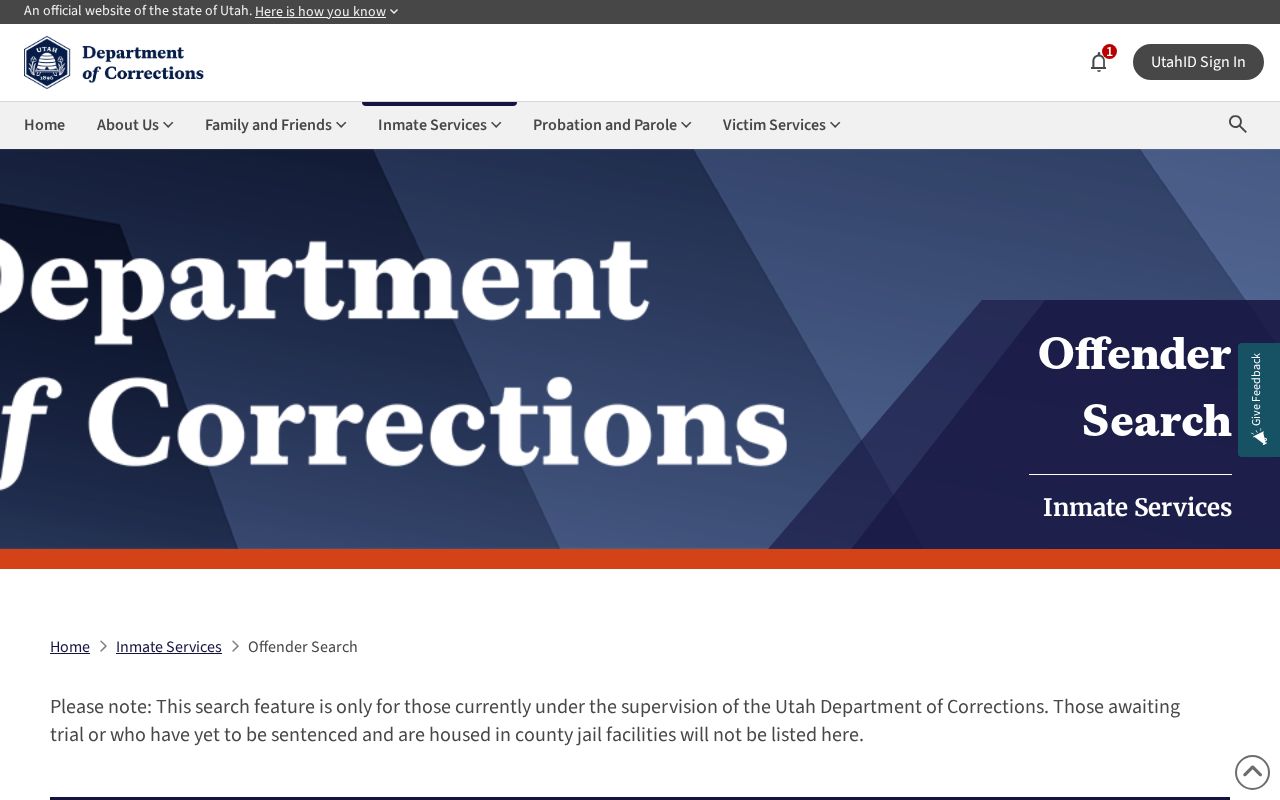
The screen is useful only for Utah corrections cases. It does not replace a Rich County Jail release record, and no result cannot by itself prove an old UDC discharge.
Rich Release Orders in Randolph Courts
Rich County Justice Court and First District Court share the courthouse contact at 20 South Main in Randolph. Justice Court generally meets on the first Tuesday of each month, subject to change, and handles most class B and C misdemeanors, infractions, and traffic matters. Felonies and class A misdemeanors belong in District Court. Juvenile court service is based in Logan, and juvenile delinquency material is not a public released-inmate channel.
Utah Courts XChange can be scoped to Rich County and the correct court. Match the person by more than a name, then read the case history for release, bail, commitment, sentence, probation, warrant, and termination entries. A court order establishes legal authority. It may precede the jail's physical processing or coexist with another hold, so write “the court ordered release” unless the custodian also confirms completion.
The official XChange entry shows the court-record route used after a person leaves a live custody system.
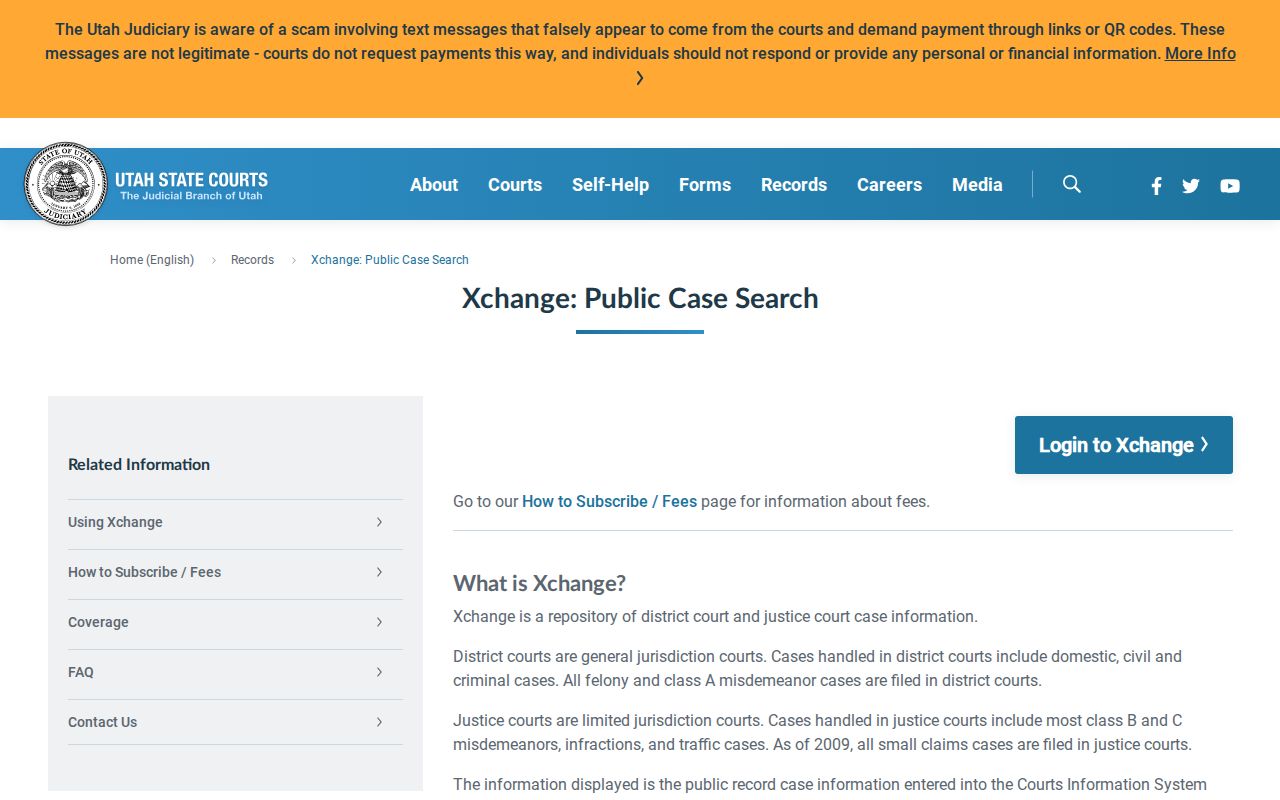
Court history can explain why Rich County custody changed, while the sheriff release record supplies the local custody end time and destination.
Tuesday Utah Prison Releases Explained
Utah prison release logistics are unusually specific. UDC says releases and paroles are normally processed on Tuesdays at the Utah State Correctional Facility. That rule applies even to most state prisoners housed at Central Utah Correctional Facility or in county contract beds. Release directly from a county jail is described by UDC as an extremely rare exception for its prisoners.
This state process must not be applied to an ordinary Rich County bond release. Rich County publishes no fixed local release day or hour. A person leaving the county jail follows the sheriff and court process for that booking. A person leaving a Utah prison follows the UDC and Board path. Confirm which legal custodian holds the case before using Tuesday as a clue.
The UDC Release Day instructions show the normal state-prison processing point and schedule.
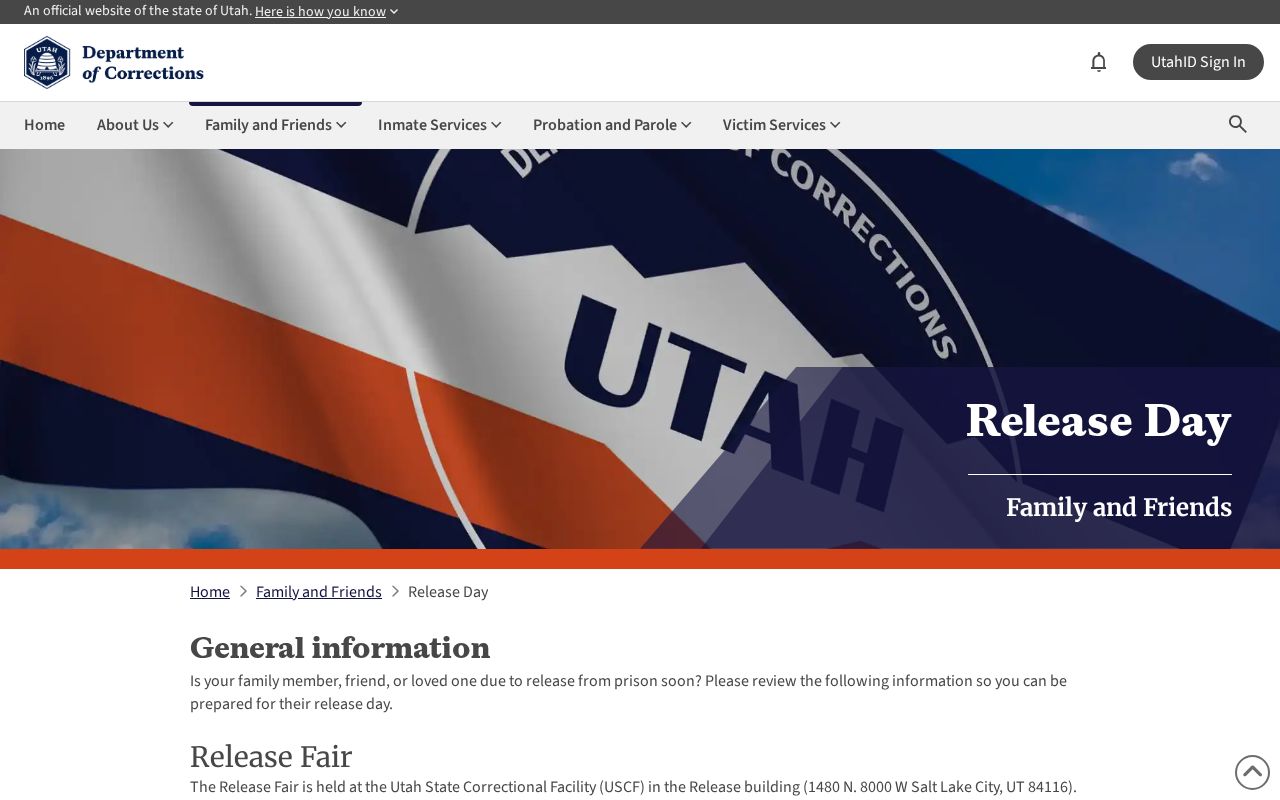
That official page helps confirm a state release plan, but it says nothing about the timing of a Rich County Jail release.
Getting Home After a Utah Release
UDC also publishes a transport fallback for release day. Family or support pickup at USCF may take one to four hours. The agency limits pickup to two people and one vehicle. A release team member or volunteer may take someone without a ride to a nearby UTA TRAX station case by case, and people without rides are processed last. A person paroling to a Community Correctional Center is transported there by UDC.
These details belong only to the state-prison path. Rich County has not published a release entrance, property process, transport plan, or pickup time for the county jail. Call the jail before traveling and do not promise a local ride or exit point based on the UDC instructions.
Rich Release Alerts and Federal Records
Utah VINE can provide custody-event notice by phone or email when the supplying agency participates and the record is current. Select Utah, match the correct person and facility, and read the exact event wording. A VINE event is notification evidence, not a permanent release archive. BOPP currently warns that alerts can be missing or inaccurate. Confirm a Rich County event with the Sheriff and a prison event with UDC or the Board.
For a federal prison case, use the BOP Inmate Locator. It may show a release date and a status such as “Released” or “Not in BOP custody” for federal records generally dating from 1982 onward. That result says only that BOP custody ended. It does not prove release from Rich County Jail or exclude supervision, USMS custody, state custody, or immigration detention.
ICE's detainee locator is aimed at present detention, and a no-result is not a discharge certificate. USMS manages federal pretrial detention and transport, so someone held on a federal matter may not yet be a sentenced BOP inmate. Preserve the Rich County transfer entry and follow the named receiving agency rather than treating disappearance as release.
Rich Released and Custody Sources
Each system answers a narrow question. Use the county source for a county booking, state tools for UDC custody and supervision, court records for legal authority, and federal tools for federal custody. A useful finding states both the system checked and the limit of its answer.
| Source | What it can show | What it cannot prove alone |
|---|---|---|
| Rich County jail or release record | Local presence, custody end, disposition, or transfer | Later status with a receiving agency |
| UDC search | Current state incarceration, parole, or probation | Past county release or full historical discharge |
| BOPP decision | Parole action, rehearing, rescission, or termination order | Completed physical exit without confirmation |
| XChange | Court disposition, sentence, release order, probation, or warrant | Exact jail-door time |
| VINE | Supplier custody event and alert options | Certified release record |
| BOP locator | Federal BOP status and release date when present | County, state, USMS, or ICE status |
Rich County Release Facility Paths
Rich County Jail is the local booking facility. Direct community releases are confirmed through the jail and Records Department; transfers must be traced to the receiving agency. Bear Lake County Jail in Paris, Idaho, is included only to prevent cross-border confusion. It is not a Rich County facility, and Idaho records control its releases.
- Rich County Jail: local sheriff record, jail phone confirmation, and the linked Utah court case.
- Bear Lake County Jail: Bear Lake County, Idaho confirmation and the Idaho case or receiving-agency record.
- Utah State Correctional Facility: UDC offender status, BOPP order, and state release-day confirmation.
- Central Utah Correctional Facility: UDC and BOPP records, with most physical releases processed at USCF.
Rich County contained no UDC prison, and UDC's April 2025 jail-program report showed no state contract prisoners in the Rich County Jail at that snapshot. The facility name and legal custodian remain essential. A missing local name can reflect direct release, transfer, an incorrect county, or a case that never belonged to Rich County.